The old one.

The new one.


If the Conoco Tower is the crown, the U-Drop Inn is the heartbeat. The two rose together in 1936, a proud Art Deco pairing along the new spine of America—Route 66. The name itself came from a schoolboy, or so the story goes. U-Drop Inn—a pun that sounds like something your uncle might say with a wink, but etched in neon, it becomes gospel. Travelers did drop in, and found more than just food. They found pause.
It’s still here. Still beautiful. Restored with the kind of care small towns sometimes give their memory. Curved counters, green tiles, the scent of something sweet. The café doesn’t serve meals anymore, not full ones at least, but it hasn’t gone quiet. Today, it serves only dessert—milkshakes spun to order and homemade pie that would make your grandmother nod in approval.
There was a chocolate pie in the case when we walked in. Not one of those over-staged, picture-perfect things. No, this was the real kind: slightly uneven, piled high, the crust just imperfect enough to tell you it was made by hand. It was calling my name. And for a moment, I almost answered. But the road was nudging me forward—always is—and so I passed this time.
Instead, I picked out a magnet. Silver wings spread across a shield, the kind of design that belongs on a gas station patch or the side of a tailfin. It promised a centennial—100 years of Route 66, just over the next hill. A century of travel, dust, and story.
Outside, the Conoco Tower still shimmered in the late afternoon sun, humming with the memory of long-gone Buicks and Fords. A few other travelers milled around, taking photos, pointing. Kids laughed, someone revved an engine a little too loud, and somewhere in all of it, I felt the rhythm of the road again.
This wasn’t just a stop. It was a slice of time, served à la mode. And next time—next time I won’t skip the pie.

It rises like a mirage, only sharper. A beacon of green and cream-colored tile shimmering under the West Texas sun, sharp as a matchstick, silent as a church. You don’t stumble upon the Conoco Tower—you see it coming. On this stretch of Route 66, where the landscape seems to stretch itself thin across the horizon, it stands like a promise. Not of salvation, perhaps, but of service. Gasoline, oil, tires. Cold soda in the cooler. A reason to stop.

Built in 1936, the Tower Station and U-Drop Inn Café were born of ambition and the architectural optimism of the day. They called the style "zigzag moderne," but there's nothing especially modest about it. This was commercial architecture with its chin up. Designed by Joseph Berry and constructed by local entrepreneurs, it was said to be one of the first businesses in Shamrock built explicitly to attract highway traffic. The idea was simple: make it beautiful enough, and people will pull over. It worked.
What amazes me is not that it survived the collapse of Route 66—most things didn’t—but that it survived the decades of indifference afterward. When the interstates came and the cars stopped pulling in, when the pumps stopped running and the café shut its doors, the tower stood. Empty, perhaps, but unbowed. It became something else—an icon not of convenience, but of memory.

And now it’s immortal in two ways: on the National Register of Historic Places, and in animated form. In Cars (2006), it became the model for Ramone’s House of Body Art—bright, stylized, instantly familiar. I wonder how many kids first came to know Route 66 not through a map or a road trip, but through a talking car and a forgotten town brought to life in pixels. If so, they still got something right—this tower belongs to dreams.

We stopped to stretch our legs. The building is now a visitor center, tastefully preserved, glowing even in the midday light. I stepped inside, but the real magic was outside. I walked slowly past where the pumps once stood, stood under the shade of the tower, and looked down the empty road. For a second, it felt like I could hear the old sounds: a bell ringing as a car pulls in, the rattle of a mechanic’s tools, a mother telling her kids to hush and eat their sandwiches.
They don’t build them like this anymore. Maybe they never really did. Maybe this one was always meant to be the last.

The Leaning Tower of Texas may not ring the same bell as Pisa’s more famous cousin, but out along the highways of the Texas Panhandle, there it stands—tilted, rusted, and proud—like a forgotten cowboy who refuses to straighten up for anyone.
Located just off I-40 in Groom, Texas, the Leaning Tower of Texas is actually an old water tower deliberately planted at a precarious angle by Ralph Britten in the 1980s to draw attention to his truck stop and tourist attraction. And draw attention it did. People slowed down. They stared. Some stopped, convinced it was mid-collapse. Others snapped photos, their own shadows long on the hot pavement. The truck stop burned down years ago, but the tower remains—defiantly askew and gloriously unnecessary.
It’s a piece of roadside theater, the kind that once defined American travel: kitsch and cleverness in equal measure. This isn’t a monument to architecture or balance. It’s a monument to marketing, to humor, and to the very human impulse to tilt the world just to see what happens.

Out in the flat sprawl just west of Amarillo, where the sky starts to feel more like an ocean than a ceiling, the Cadillacs rise from the earth like the bones of some forgotten beast. Ten of them, nose-down, tailfins skyward, planted in a row like a crop of chrome prayers—each one a monument to motion and myth, and each one covered in the chaos of a thousand layers of paint.
This is Cadillac Ranch, a roadside shrine to the absurd and the iconic. We rolled in under a flawless Texas sky—blue enough to sell—and joined the other pilgrims in the dirt lot, each of us holding something to leave behind.


At the edge of the field stood a little trailer, sun-bleached and humming with the soft whir of fans and friendly chatter. Inside was every flavor of roadside Americana: t-shirts, stickers, sunglasses, and souvenirs that leaned into the weirdness. I made a beeline for the magnet rack and found exactly what I didn’t know I needed—a bold design with those slanted Cadillacs stretching across the plains in bright cartoon color. I added it to my growing collection without hesitation.
But that wasn’t all. This place isn’t just for looking. It’s for marking.

So I picked up a can of True Blue spray paint. The color matched the sky, almost defiantly, and seemed a fitting way to leave something behind—however fleeting.
We made the short walk out to the cars, the gravel crunching underfoot, the wind teasing hair and hat. The Cadillacs looked even stranger up close, like old dreams dragged from the junkyard and stood up as folk art. The smell of aerosol hung in the air—a mix of rebellion and ritual. You could see the years in the paint: the drips, the names, the hearts and slurs and hashtags piled layer upon layer. This wasn’t preservation. This was permission.
 |
| ARMSTRONG LIVES |
I shook the can and found a small patch of metal that hadn’t been claimed in the last five minutes. It’s not easy—real estate is competitive out here—but I made room. A quick blue arc, nothing profound, just proof. I was here. I saw this.
That’s the beauty of Cadillac Ranch. Nothing you do here lasts. Someone will cover it up in a day or an hour or even ten minutes. But the act of doing it matters. It’s collaborative impermanence. A gallery that reinvents itself with every passerby.
 |
| THANKS CHUCK 39 GREAT YEARS! |
We stood for a while after painting, watching others take their turn. Kids giggling while they scrawled their names, couples spray-painting hearts, one guy writing a full sentence before realizing it would be gone by sundown. It was all beautiful. It was all temporary.
That’s what makes it special.
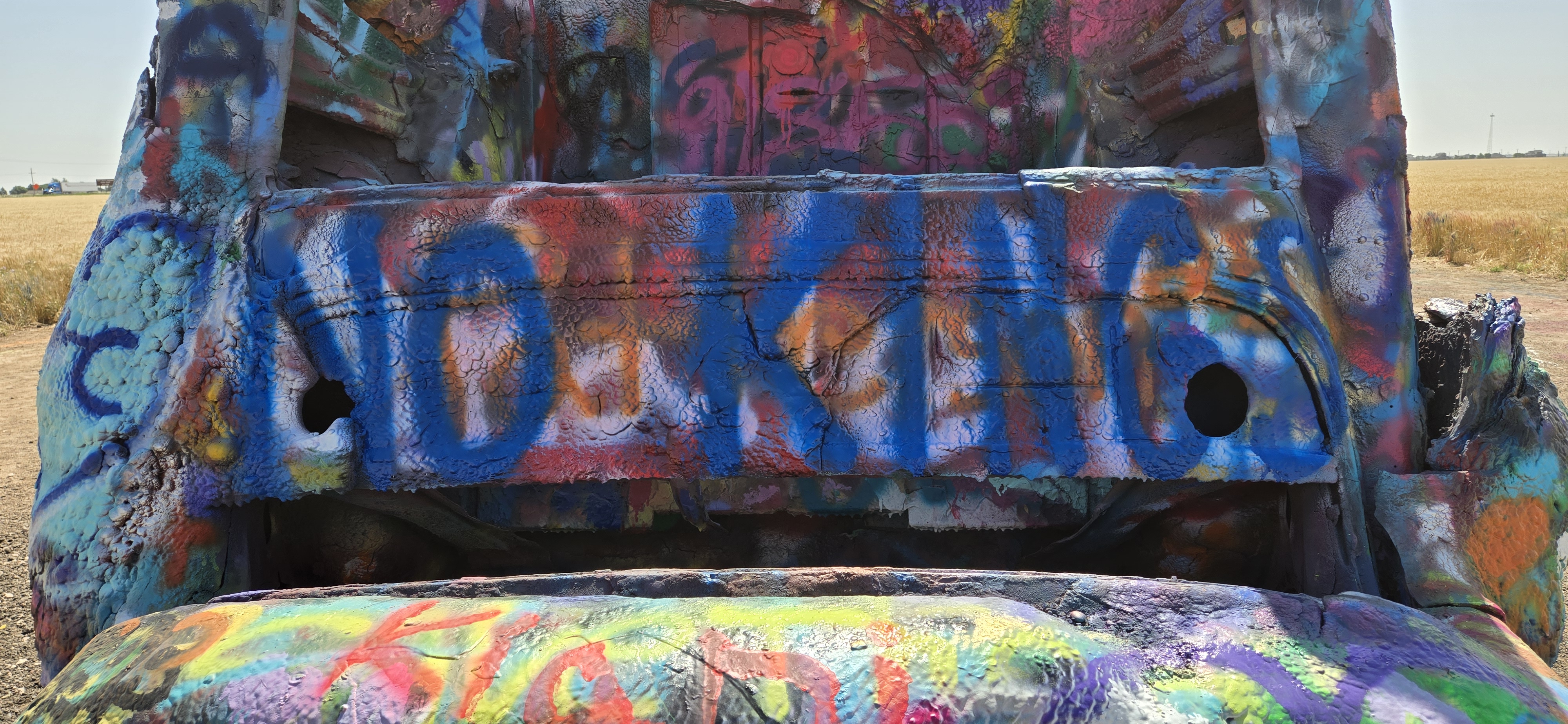 |
| NO KINGS |
Cadillac Ranch doesn’t ask you to admire it. It dares you to change it. And that’s exactly what we did. With a can of blue and a patch of steel, we added ourselves to the road’s long story—knowing full well we’d be painted over by morning.
And somehow, that made it all the more permanent.

Just past the midpoint line and the promise of Ugly Pie, we found ourselves at Dream Maker Station—a modest old service station dressed up in memory and grit. It sits quietly alongside Route 66 in Adrian, Texas, not trying to be anything it’s not. But that’s what makes it special. Because somehow, in being exactly what it is, it became part of something much bigger.
This is one of the places that helped inspire Cars. The Pixar team came through here, met the locals, walked this very stretch of pavement. Radiator Springs didn’t come out of thin air. It was pulled together from places like this—from people like the woman who stood behind the counter when I walked in.
She greeted me with a kindness you don’t find in chain stores, the kind born of pride and patience. We talked as if we’d known each other longer than a minute. I told her I was traveling Route 66 and picking up magnets as I went. She lit up. “Well,” she said, “you’ve come to the right place.”
There were a few options, all lovingly displayed near the front—Route 66 shields, designs with old garage pumps, one that mimicked the Midpoint Café’s cheerful logo. But one magnet stood out.
It didn’t just speak to the past. It looked to the road ahead.
A silver and black shield with wings, bold and clean. Across the top: 100 Years. A tribute to next year’s centennial celebration. A reminder that this road—this strange, stubborn ribbon of asphalt—has lasted a century and still carries meaning. It was beautiful. It was hopeful. And it was coming with me.
“I like that one too,” she said, as I picked it up. “It’s not just about where we’ve been. It’s about what comes next.”
We stood a little longer talking about the café down the street, about travelers who grew up on Cars now walking in with their own kids, about what it means to preserve something—not in amber, but in spirit.
Before leaving, I thanked her and slid the magnet into the glovebox where it joined Glenrio and Tucumcari and all the other little tokens I’ve gathered on this pilgrimage west. My wall back home is going to look like a shrine to the American road—and that feels exactly right.
Outside, the old pump cast a long shadow in the morning light. Dream Maker Station might look like a quiet little stop, but it carries a strange electricity. Pixar may have given it a second life, but it never really died. It was just waiting—like so much on Route 66—for someone to slow down long enough to see the beauty in something built to last.
And with that magnet in hand, I didn’t just leave with a memory.
I left with a promise to come back. For the next hundred miles. For the next hundred years.

We pulled up to the Midpoint Café with a kind of reverent anticipation—the kind usually reserved for sacred sites or long-promised desserts. The café sits just a stone’s throw from the official midpoint line in Adrian, Texas, and it beams like a neon-flavored time capsule: red trim, chrome edges, and windows that beg for sunlight and Polaroids.
I was already dreaming of the pie.
Ugly Pie, to be specific. The stuff of Route 66 legend. Baked with intention, served without apology, and made famous not just by the travelers who swear by it, but by the Pixar team who passed through on their way to building Radiator Springs. If Flo’s V8 Café in Cars feels familiar, it’s because it has roots here—at a diner where every crack in the linoleum and lean of the barstool tells a story.

But fate had other plans. A modest paper sign taped to the door told me what I didn’t want to read: Closed Monday & Tuesday. And wouldn’t you know it—we were there on a Monday.

No pie. No booths. No slow coffee with 66 salt in the air.
I stood at the door a long moment, hand still resting on the handle as if it might unlock out of sympathy. It didn’t. But even then, I couldn’t bring myself to be bitter. Because the place was still there. The heartbeat of it still hummed through the windows. The signs still fluttered in the breeze. And the promise of Ugly Pie still lingered, just out of reach.
I’ll be back. Of course I will.

Not just for the pie, but for the principle. Because some things are worth the return trip. And when it comes to Route 66, nothing says loyalty like doubling back for a slice of something handmade and honest.
Besides, I already have the magnet. Now I just need the memory to match.

The midpoint of Route 66 is not a place you arrive at with fanfare—it’s a simple white line painted across the road in Adrian, Texas, flanked by a sign that reads “Midpoint, Route 66, 1139 miles to Chicago, 1139 miles to Los Angeles.” That’s it. Just balance point and fact. A mathematical curiosity made flesh.
And yet, standing there, it felt like more than that.

There’s something profoundly satisfying about symmetry in a world that rarely offers it. We’d been chasing the old highway for days by this point—detouring through time, through ghost towns and neon memories—and then, here we were. The center. The very heart of the journey. Halfway there and halfway home, depending on how you look at it.
Adrian itself is tiny. A handful of buildings, a stretch of dusty frontage, and the sense that if you blinked at the wrong moment, you’d miss the whole town. But it doesn’t feel forgotten. Not exactly. There’s pride here. And permanence.

It’s not a place you end up unless you meant to. Which, somehow, makes it feel earned.
We parked the car, stepped into the middle of the road (something you can do here without much worry), and took our photo at the sign. Then we just stood there for a while, letting the silence fill the space where highway noise should have been.
Midpoints are funny things. They don’t come with balloons. They don’t reward you for arriving. But they mark you just the same.

We weren’t the same people who started this trip. And we weren’t yet the people we’d be when we finished it. But here, in Adrian, Texas, we could at least name that space in between.

Glenrio is the kind of place that makes you pull over—not because there’s anything urgent to see, but because something about it asks you to stop. A bone-dry ghost clinging to the state line, Glenrio is my favorite kind of weird: a border town with no border patrol, just a faded welcome sign and the hollow whisper of what used to be.
The town sits exactly between Texas and New Mexico, and for most of its life, that fact made everything a little strange. Gas stations set up on the Texas side, where fuel taxes were lower. Bars and motels took root on the New Mexico side, where alcohol laws were looser and Sunday restrictions a little more forgiving. Meanwhile, the post office sat in Texas, meaning your letters were Texan but your liquor was not. It was a town that belonged to both states and neither, a living tug-of-war in miniature, conducted through the language of commerce, convenience, and Prohibition-era ingenuity.

Before Route 66 gave it a second identity, Glenrio started out as a railroad town. The Rock Island Line rolled through here in the early 1900s, and the town sprung up like a desert bloom—brief but intense. It wasn’t long before travelers replaced train cars, and by the 1930s, Glenrio had transformed into a bonafide pit stop for the automobile age. Motels, diners, service stations. All the archetypes of the Mother Road stitched together in miniature.
During Prohibition, it became a sanctuary of sorts—if not in law, then in spirit. Texans looking to wet their whistle could simply cross the street into New Mexico, buy a bottle, and be back in their dry county before the ink on their receipt dried. Glenrio wasn’t just a place to refuel; it was a loophole in physical form, a town built on the idea that geography could be gamed.
It thrived through the mid-century heyday of Route 66, its businesses welcoming caravans of dust-covered families heading west to California dreams or east to wherever they had to be. But then came the Interstate. I-40 bypassed Glenrio in the late 1970s, and within a decade the town emptied out like a diner after last call.

Now, what’s left feels like a mirage that forgot to disappear. The Little Juarez Café is a crumbling shell. The gas stations are skeletal. The motel signs still reach skyward, but their arrows point to nothing. Except—of course—the smoke shop. The only remaining business, and somehow the most poetic. In a town once built on border loopholes, it’s fitting that the last holdout is still selling something half-legal and entirely surreal.
Glenrio is a border town without border drama. It’s not split by language or politics, but by taxes and time zones and half-remembered laws. Still, it belongs to two worlds: East and West, past and present, Texas and New Mexico. And maybe that’s what draws me to it. Not just the strangeness, but the way it sits in its strangeness, unbothered. Not trying to be remembered—just refusing to be erased.
It’s a place that reminds you: history doesn’t always leave in a hurry. Sometimes it lingers in the dust and waits for someone to wander through with just enough curiosity to ask, What happened here?

We pulled into the Blue Swallow just after 8 a.m., the sky the soft color of morning bone and the shadows still long across the old pavement. The neon had been switched off for the day, but the motel was already alive with quiet energy. A small knot of early risers had gathered out front—Route 66 lifers, sipping coffee out of dented thermoses, speaking in the shorthand only road travelers understand.
We stepped inside, and that’s when I met him—the proprietor. He stood behind the desk with the kind of easy calm that comes from living with the weight of history and the rhythm of headlights. He greeted us with a warm nod, as if we were regulars instead of two wanderers just stopping in for a breath.
When I mentioned I was from Carthage, Missouri, his whole face brightened. “Boots Court!” he said immediately, as if he'd been waiting for someone to bring it up. We were off to the races.
There’s a strange kind of kinship that happens when two people realize they live on the same forgotten spine of America. I told him I lived right on Oak Street—Route 66 back home. He grinned and leaned on the counter, and for a few minutes we weren’t strangers. We were neighbors, both tending different ends of the same long memory.
We talked about the road. About the people who come in just to see the neon. About the ones who remember it from when it still mattered in the logistical sense—before the Interstates gutted the small towns and the journey lost its texture. He told me stories about guests from all over the world, all making their own pilgrimage on the old mother road.
We talked about the centennial. One hundred years next year. It’s not just an anniversary—it’s a resurrection. A reminder that something doesn’t have to be fast to be meaningful. That sometimes the best places are the ones you have to slow down for.
Before we left, he handed me a sticker and a postcard, the kind of souvenirs that feel more like totems when given with sincerity. “Tell your folks at Boots Court we’re keeping the lights on,” he said with a smile.
As we pulled back onto the road, I glanced in the rearview mirror at the pale pink sign with its swallow frozen mid-flight, glowing softly in the morning sun. Not every motel makes you feel like you're part of something larger. But the Blue Swallow does.
It doesn’t just preserve Route 66. It believes in it. And in that belief, it invites you to believe too.

Tucumcari, New Mexico is a town that whispers in neon and hums with ghosts of the open road. You don’t pass through Tucumcari by accident—not even now. Even in its quieter modern state, it seems to sit posed for a photograph that no longer gets taken, holding its breath in case Route 66 decides to come back.
We pulled into town under a sky the color of scorched denim, the kind of western blue you only find in desert states that don’t know how to do soft weather. Tucumcari was our first real stop on the long drive home, a detour made possible by our unexpected extra day. And while most people race across New Mexico on the interstate, we were here because we wanted to be. That’s the magic of an extra day—it gives you permission to get lost on purpose.
The town still clings proudly to its Route 66 identity. In fact, it might be the most concentrated dose of 66 nostalgia left standing. Neon signs—restored or sun-bleached—line the main drag like aging showgirls still ready to dance if someone starts the music. There's the Blue Swallow Motel, which has been glowing since 1939, its garage bay rooms a throwback to when motels cared whether your car slept well too. Murals coat the sides of buildings, and rusted-out gas stations now serve as roadside shrines to the Mother Road.
Route 66 was never just a road. It was a promise—that America could be wide open and waiting, that the journey mattered more than the arrival. And Tucumcari? Tucumcari was that promise in miniature. In the heyday of cross-country road trips, it offered more than fifty motels, a staggering number for a town its size. It boomed on the mythology of movement. But then came the interstate. Faster, smoother, blander. The kind of road that takes you somewhere, but never lets you feel where you are.
Tucumcari didn’t dry up entirely like some other Route 66 stops, but the town did shrink into its shell a bit. There’s something both proud and poignant about how it has kept its roadside soul alive. It refuses to be forgotten.
We walked the sidewalks and took photos of old signs lit up against the late afternoon sun. We peeked inside souvenir shops that smelled like dust and dreams, flipped through postcards no one sends anymore. An old man sweeping his front stoop waved without stopping. He’s probably been waving at travelers his whole life.
There's a saying the town used to promote: Tucumcari Tonight!—painted on barns and billboards across the Southwest, beckoning drivers to stop for the night. That slogan still lingers here, not just in paint but in attitude. The town wants you to stay, even if it knows you won’t.
But we did stop. We did linger. We let Tucumcari speak its piece.
If roads have souls, then Route 66 is a wandering ghost, and Tucumcari is the town that set a place for it at the table, still pouring the coffee, still waiting for headlights on the horizon.

Dear journal,
It was a squat little building off Route 66, the kind that would be easy to overlook if not for the towering sign that once proclaimed, with defiant simplicity, “Red’s Giant Hamburg.” No “er.” Just Hamburg. As if Red himself didn’t have time for the rest of the word. He had burgers to make, orders to take, and knives to drum on countertops.

I found myself there again today—not the original, of course, which was razed in ’97—but the loving reincarnation resurrected on Sunshine Street. Neon nostalgia lives on, even if the bones are new. What draws me isn’t just the menu (though I won’t deny the root beer still slaps). It’s the history. This was the first drive-through restaurant in the world. Long before golden arches or paper crowns, there was Sheldon “Red” Chaney and his wife Julia, serving burgers through a window in a converted Sinclair gas station. That was 1947. By ’48, he’d rigged up a speaker system and invited folks to stay in their cars. America hadn’t even invented the teenager yet.

There’s something deeply American about the whole thing. Route 66 humming with possibility. A guy with red hair and a vision. Burgers and root beer and the freedom to eat in your Chevy. Red didn’t just serve food—he performed. Stories say he’d leap the counter to deliver an order, or play percussion with kitchen knives when things slowed down. The place wasn’t just a restaurant; it was a roadside theatre.
It closed in 1984. Red died not long after. But the memory lingered, like grease in the air of a beloved old diner. Then, in 2019, two local men brought it back. Rebuilt it with care. Honored the legacy. I’m grateful for that.
And now, just six years later, it’s up for auction again. Financial strain, the weight of a pandemic, the slow fade of small dreams. The current owners are letting it go on May 15. Maybe someone will save it. Maybe not.
I stood out front today under that faithful sign. Watched cars roll through. Thought about Red, and how strange it is that something as simple as a hamburger window could change the way a nation eats. Maybe even how it lives.
We build shrines to speed and convenience now. Everything is instant. Everything is franchised. But Red? He was just trying to make a living—and maybe make people smile along the way.
I bought a root beer and sat in my car. Didn’t scroll. Just listened to the fizz and thought about how often the world turns on the smallest of hinges. A window. A speaker. A hamburger with no “er.”

Maybe that’s all any of us need to leave a mark. Just one good idea—and the guts to leap the counter.
Always,
Dave


